Start With the Main Constraint
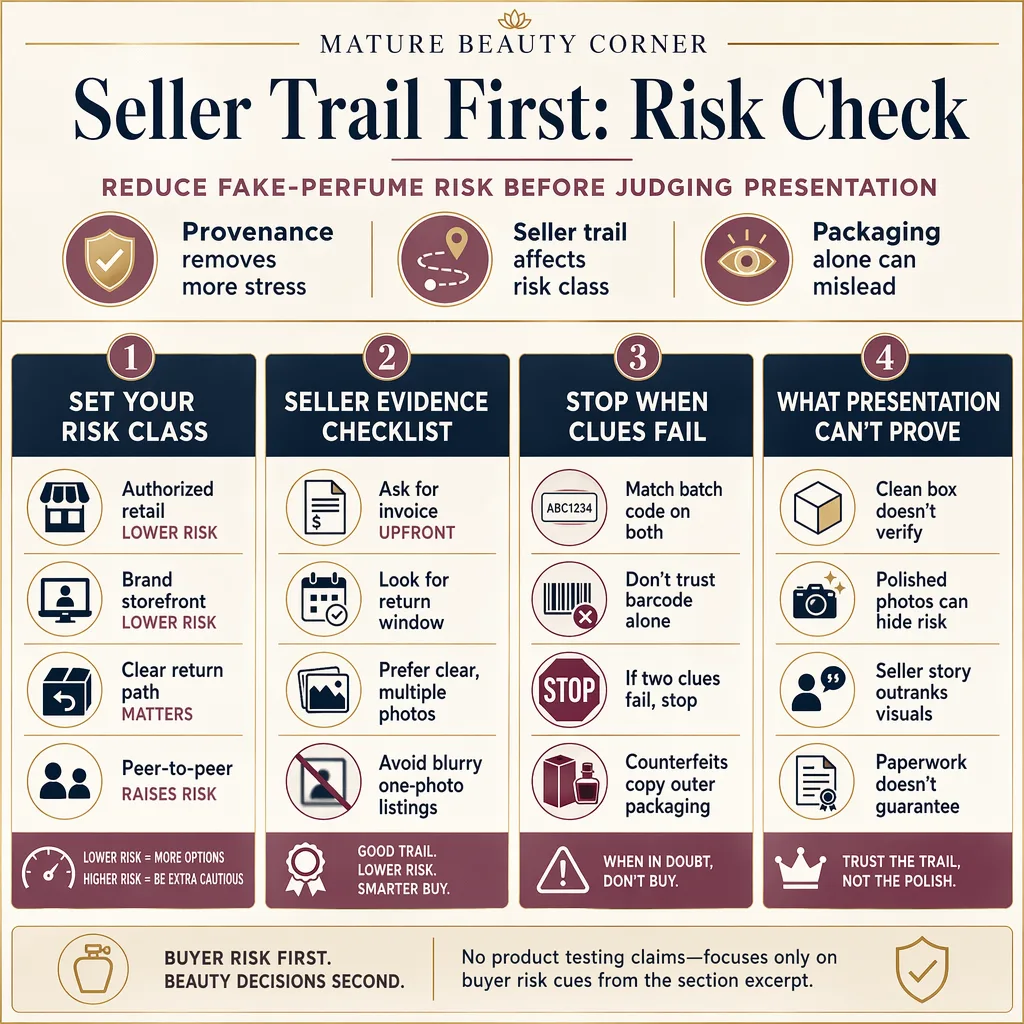
A clean box does not clear the bottle. Counterfeiters copy outer packaging first because that is what shoppers see online, and a polished presentation hides a weak seller story. For mature buyers who want a signature fragrance that feels dependable every time, provenance removes more stress than any single visual trick.
| Check | Strong sign | Red flag | What it misses |
|---|---|---|---|
| Batch code | Same code on box and bottle, crisp and legible | Missing, mismatched, or poorly printed code | Some genuine testers, samples, and older formats use different packaging |
| Box print | Even spacing, sharp text, clean folds | Blurry text, crooked logo, rough seams | Good counterfeits imitate boxes well |
| Bottle and cap | Cap seats flush, collar looks even, sprayer sits centered | Wobble, loose fit, rough glass seam | Some authentic designs use unusual caps |
| Seller trail | Authorized seller, invoice, return window | Evasive answers, no receipt, no return path | Good paperwork does not guarantee authenticity |
| Juice condition | Clear liquid, consistent fill line, clean neck | Residue, leakage, cloudy appearance | Color alone does not prove anything |
Quick authenticity triage
- Confirm the seller type first.
- Ask for front, back, base, cap, and batch code photos in the same lighting.
- Match the batch code on the bottle to the box, not the barcode.
- Check the print, seams, and cap fit.
- If two or more clues fail, stop.
Most guides tell shoppers to start with the scent. That is wrong. Scent comes last because opening notes shift with air exposure, storage, and skin.
The Comparison Points That Actually Matter
Batch code, bottle hardware, and seller documentation carry more weight than barcode, cellophane, or a pretty box. The barcode is public retail information, so counterfeiters copy it easily. The batch code is the better trace point because it ties back to production, not just packaging.
The bottle itself tells a quieter story. Look at the neck, collar, spray head, and cap alignment. A bottle that rocks when the cap is seated, or a sprayer that sits visibly off-center, deserves suspicion even if the box looks neat.
Do not judge authenticity by scent alone. A harsh first spray does not prove a fake, because fresh openings and certain compositions smell sharp. A familiar dry-down also does not prove authenticity, because some copies imitate the broad scent profile while failing on packaging and hardware.
The strongest pattern is consistency across clues. One clue can be copied. A whole cluster of matching details is harder to fake.
What You Give Up Either Way
Fast visual checks save time, but they miss well-made fakes that reuse convincing packaging. Seller verification lowers that risk, but it costs patience and often removes the lowest price listing from consideration.
The premium alternative is simple: buy from an authorized source and keep the receipt. That route adds less friction later, especially for a gift or a bottle that will sit in a fragrance wardrobe for regular wear. The trade-off is cost up front, but the ownership burden drops because returns, exchanges, and questions are cleaner.
A gray-market bargain asks you to do the detective work yourself. If the price sits far below the usual retail range, the verification burden moves onto the buyer. For a mature shopper, that extra burden is the real cost, not just the sticker price.
Comparing Spot Fake Perfume Across Scenario
Different buying situations change which clue matters most. A sealed department-store bottle needs less forensic work than a partial bottle from a marketplace listing. A vintage fragrance needs different judgment than a current release.
| Scenario | Best-fit focus | Main risk |
|---|---|---|
| Sealed bottle from an authorized retailer | Seller trail, batch code, clean packaging | Overchecking minor cosmetic differences |
| Open-box resale | Base, cap fit, sprayer, seller photos | Trusting a neat box too much |
| Tester or sample | Source documentation, not retail packaging | Expecting standard retail wrap |
| Vintage or discontinued bottle | Provenance, code placement, known box variations | Mistaking age-related packaging changes for fraud |
| Gift set | Seal style, box integrity, seller history | Assuming every extra component proves authenticity |
Best-fit scenario box
- Choose visual checks first when the bottle is sealed and the seller is known.
- Choose provenance first when the bottle is open or discounted hard.
- Choose return protection first when the bottle is a gift.
- Choose a conservative read first when the fragrance is discontinued or vintage.
For a daily signature scent, reliability matters more than the thrill of a bargain. A fake bottle does not just waste money, it also adds uncertainty to something meant to feel polished and repeatable.
Constraints to Confirm for How To Spot Fake Perfume
A photo-only decision has hard limits. Lighting changes the color of juice and box print, camera compression hides weak edges, and some brand redesigns make old comparison photos useless.
Ask for the right evidence before you judge the bottle. The seller needs to show the front, the back, the base, the atomizer, the cap interior, and the batch code in one clear set of images. If the seller avoids any of those, the listing lacks enough proof.
No universal batch-code map exists across fragrance houses. Some brands place the code on the box flap, some on the bottom, some on the bottle base, and some change the format over time. That is why a mismatch is serious only after the brand’s own placement pattern is clear.
Refills, testers, travel sprays, and international releases also change the game. A tester often skips the polished outer box, and a travel spray uses different hardware by design. Compare like for like, or the check turns into a false alarm.
Routine Checks
Keep the packaging until the return window closes. That single habit preserves your options, and it gives you proof if the seller asks for photos later.
Photograph the batch code, bottle base, and outer box before the first spray. If the bottle arrives damaged, leaked, or missing a code, those pictures become the cleanest record. Once the box goes into recycling, the annoyance cost rises sharply.
Store the bottle away from heat and bright light. Heat changes perfume over time, and that later change muddies any authenticity complaint. A bottle that sat on a sunny vanity is harder to judge than one kept in a cool drawer.
Check the atomizer after the first few uses. Uneven spray, leakage around the collar, or a cap that no longer fits cleanly after normal handling deserves a second look. That does not prove a fake by itself, but it does justify saving every bit of documentation.
Published Details Worth Checking
Verify the seller’s listing against the brand’s own naming and packaging details before you buy. A lot of fraud slips through because the listing looks polished while the small facts are wrong.
- Confirm whether the item is a full retail bottle, tester, sample, refill, or travel size.
- Confirm the return policy in writing.
- Confirm the batch code location and format from the seller’s photos.
- Confirm whether the packaging is a current version or an older revision.
- Confirm the stated size and concentration, since mismatches there are easy to miss.
The useful detail is not just the presence of information, but the consistency of it. A listing that changes the bottle size in one place and the product title in another deserves extra caution. Counterfeit listings often lean on broad familiarity, not exact description.
- For older or discontinued bottles, match the bottle to the era it claims to be from rather than to a current product photo, and cross-check seller records and the brand’s support channel.
- In secondhand perfume, storage matters almost as much as counterfeit risk: a genuine bottle that sat in a hot car, a bright bathroom, or a warehouse shelf can smell flatter, darker, or duller than fresh stock.
- Spelling errors, sloppy alignment, or a photocopied-looking logo on the box are warnings. A strange seam or excess glue raises suspicion but does not settle the question alone.
- A soft-touch carton scuffs faster than a shiny one, so a lightly worn box from a trustworthy seller can read as more believable than a pristine box from an unfamiliar listing.
- A working atomizer gives a fine, even mist on the first press, not a spit, dribble, or heavy stream.
Who Should Look Elsewhere
Anyone buying a fragrance as a gift should skip the risky shortcut and use an authorized source. Gift purchases leave less room for seller back-and-forth, and a return process becomes awkward fast if the bottle looks off.
Anyone who wants a discontinued scent from a peer-to-peer listing should expect a high verification burden. That burden is not worth carrying if the seller refuses close-up photos or avoids questions about provenance.
Anyone shopping a decant or sample should not judge the bottle by retail packaging rules. The right question is where the decant came from and who handled it. Packaging clues lose force when the original bottle is no longer in play.
Anyone who wants a low-drama fragrance wardrobe should also skip any listing that hides key details. A cheap bottle with missing photos, no invoice, and no return path is a future nuisance, not a value purchase.
Final Buying Checklist
Use this short sequence before you commit money.
- Identify the seller type.
- Ask for front, back, base, and batch code photos.
- Match the code on bottle and box.
- Check font quality, seams, cap fit, and sprayer alignment.
- Read the return policy before paying.
- Walk away if two or more details do not line up.
- Save every photo and the order record until the return window closes.
The cleanest rule is simple. One mismatch starts a conversation, two mismatches end the purchase. That threshold keeps the decision practical and stops the bargain from becoming an expensive guess.
Common Misreads
Most guides overrate cellophane. That is wrong because shrink wrap is easy to copy, and many genuine bottles ship with different seals or no wrap at all.
A strong opening blast does not prove authenticity. Some legitimate perfumes smell sharp right away, and some counterfeits do not reveal themselves until the bottle details are checked.
A missing batch code is a red flag, but it is not the entire verdict. Testers, samples, and some older bottles use different formats, so the code has to be read in context.
A darker juice color does not automatically mean fake. Light, heat, and age change the liquid over time. Color belongs in the evidence stack, not on its own.
A perfect-looking box is not enough. Counterfeiters know the box is what shoppers photograph first, so a neat exterior can hide a weak bottle and a shaky seller trail.
The Practical Answer
Start with the seller, then the batch code, then the bottle hardware. Use packaging only as part of the picture, not as the whole judgment. If the seller cannot show the bottle base, code, and sprayer in clear light, the listing is not ready for trust.
For gifts and everyday wear, authorized retail is the cleanest path. For vintage, testers, and decants, provenance matters more than polished wrapping. If suspicion remains after two mismatches, stop using the bottle and ask for a return or report the listing.
FAQ
How many signs do I need before I call perfume fake?
Use two or more mismatches across source, packaging, and bottle details. One flaw starts a closer look, but one flaw alone does not settle the question.
Is a batch code enough to prove a perfume is real?
No. A batch code is useful, but it does not stand alone. Pair it with seller provenance, bottle hardware, and matching packaging details.
Does missing cellophane mean the perfume is fake?
No. Cellophane is a weak clue because many genuine bottles ship without it, and counterfeiters copy it easily. Check the seller and the bottle itself instead.
Why does an authentic perfume sometimes smell different from one bottle to another?
Storage, age, and concentration change how a perfume smells. That is why scent belongs after the packaging and source checks, not before them.
What should I do first if I suspect I bought a fake?
Stop using the bottle, photograph everything, and contact the seller right away. Keep the box, the order record, and every message until the issue is resolved.
Are testers and samples harder to verify?
Yes, because they often use different packaging from retail bottles. Provenance matters more than outer presentation for those formats.
Can the barcode tell me if a perfume is authentic?
No. Barcodes are public retail identifiers, so they do not prove authenticity. Batch codes and seller trail carry more weight.
Is a cheap price always a warning sign?
A deep discount is a warning sign when the seller cannot document the bottle. Price alone does not prove fraud, but a low price plus weak proof creates real risk.
See Also
If you want to move from general advice into actual product choices, start with How to Choose a Travel Perfume for Handbags: Scent, Size, and Sprayer Tips, How to Choose Warm Fragrance Notes: A Complete Guide, and What to Look for in Makeup for Wrinkles and Fine Lines.
For a wider picture after the basics, Dolce & Gabbana the One Perfume Review: What You Need to Know Before Buying and Billie Eilish Perfume Review are the next places to read.